

The month-end scramble is a term most construction accountants know a bit too well.
You spend the first week of every month in a blur of emails and spreadsheet gymnastics to figure out where your projects stand. It often feels like a race against a clock that is ticking way too fast for comfort.
But most of that chaos usually comes from tasks being out of sequence. Not because your team is slow.
So how can you turn the month-end close into a smooth workflow that happens all month long and completes on time? By starting early and meeting with your operations team weekly to get updated on the work.
The following guide will walk you through the checklist for making that happen. At the end, we’ll also share a free month-end close calendar that maps out every step for you.
The 5-Step Proactive Construction Close Checklist
Here’s a 5-step construction close checklist that you can follow.
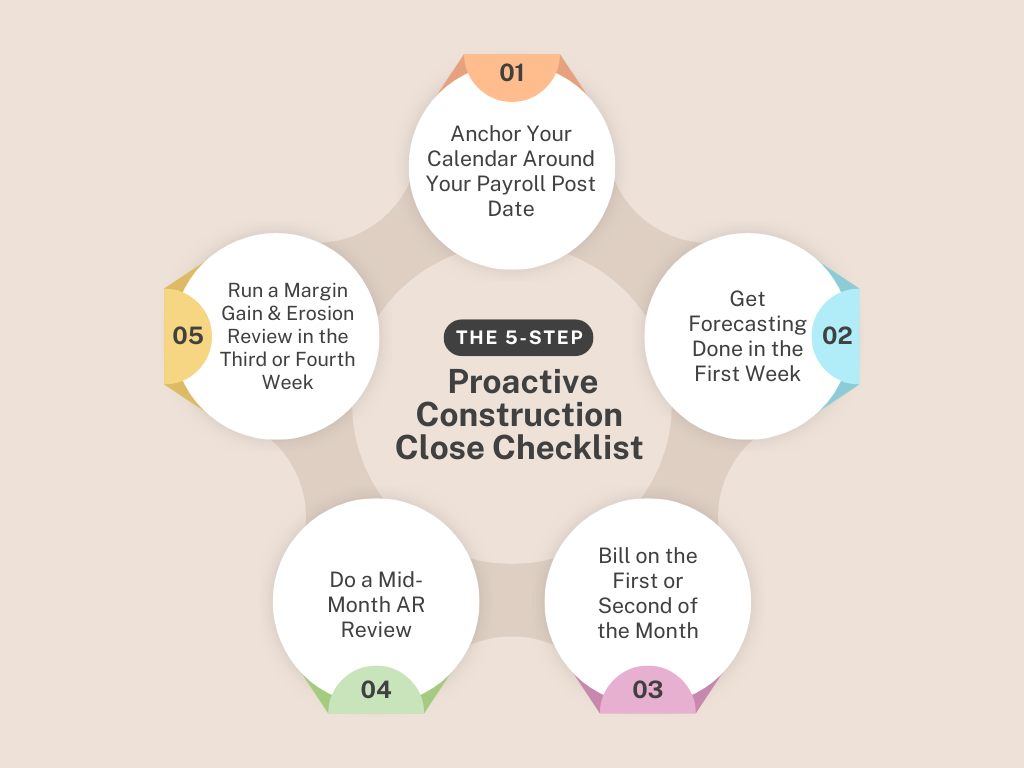
Step 1: Anchor Your Calendar Around Your Payroll Post Date
In most places, the month-end close around arbitrary dates.
But in construction, we don’t have to do it like that because there already exists a natural anchor point for us to build our month-end close processes around.
It’s the date when the previous month’s payroll gets posted in the ERP system (not to be confused with the pay date or payroll end date).
For most construction companies that pay on a weekly basis, this day falls on Wednesday of the first week of the new month. And sometimes, if you’re a union contractor with mid-week payroll deadlines, this day can come as early as Monday or Tuesday of the first week of the new month.
But why should you do the month-end exercise around this time? Because the month-end close should be timed around the days when the actuals of the last month are freshly posted into the ERP and are also fresh in the collective memory of your team.
We have seen companies ask their PMs to forecast around the 12th or 15th of the month. But that’s too late. They’re basically setting up their PMs to come up with a bad forecast.
Around that time of the month, it’ll require intense mental gymnastics from the PMs to try to remember what happened before and after the month changed over. They’re also working through a full active project schedule by this time, which further complicates things.
So once payroll is posted, you also want to cut off AP and AR entry for the prior month on that same day. That way, your project managers are forecasting on a Thursday or Friday of that first week. They will have a complete picture of all their actual costs.
Step 2: Get Forecasting Done in the First Week
Once forecasting starts, your PMs have a 48-hour window to get it done. The target should be Thursday and Friday of that first week.
The reason for that tight window isn’t arbitrary either. It’s because the executive leadership team needs to meet the following Monday, or no later than Tuesday, to do the WIP review.
And that WIP review can only happen if all the forecasts are already in. If even one PM hasn’t submitted their numbers, that meeting can either get delayed or proceed with incomplete data, neither of which is a good outcome.
Your month-end close calendar can prevent this from happening by laying out the entire sequence in a Gantt chart. Your PMs will see that if they don’t turn in their forecasts by Friday, the entire leadership team’s WIP review on Monday gets delayed. This will prevent them from delaying their forecast.
Now, the WIP review meeting itself is worth talking about a little here, too.
Make sure you organize all your PM forecasts separately from their overridden versions that will come out of the WIP review meeting.
You wouldn’t want the finance team to make adjustments right on the original versions of the PM’s forecasts. Because the moment the original forecasts and adjustments get blended together without separate tracking, you lose:
- Visibility into whether your PMs are forecasting accurately over time
- Ability to explain adjustments to your surety, your bank, or your private equity partners if it ever comes to that
Step 3: Bill on the First or Second of the Month
If your forecasting happens Thursday-Friday of the first week and your WIP review also wraps up by the following Monday or Tuesday, you should be in a position to get your billings out on the first or second of the next month.
But to achieve that, you will have to do the prep work in the last week of the prior month.
You should have a conversation with your PMs regarding the approved change orders in the last week of every month. In that meeting, you will work out the answers to the following:
- What do we currently have in pending change orders?
- What do we have in approved change orders?
- Has accounting received the approval emails from the client?
- How does the owner want approved change orders reflected on the AIA billing? New line item, or added to an existing line?
When you have those answers before the first, you’ll be just billing on the first or second of the month. There won’t be any confusion about whether something is approved or how to format the billing. All that prep work would have been done by then.
And right when the billing process is over on the first or second of the month, with the invoices at your disposal now, the AR process starts. Send over the invoices to your clients right then.
Step 4: Do a Mid-Month AR Review
Clients whose payments haven’t come in after the first nudge can be followed up mid-month once again. At that time, you’ll be following up on a 45-day-old invoice, and that’s a much stronger position to be in.
This mid-month follow-up is a must. You shouldn’t wait until the month-end to review who has paid and who hasn’t. Why? Because by then the invoice is already 60-70 days old, and a conversation with the client can get awkward.
The mid-month follow-up is also about silently burning through most of the common excuses of clients. At around the 15th, excuses such as the following don’t hold up anymore:
- “The check is in the mail.”
- “We only release ACH payments on Fridays.”
- “It’s in our queue for next week.”
The PM will pick up the phone to have a serious conversation with their client contact about the payment.
But before this happens, there needs to be an AR review meeting between the finance and the PMs.
The following things are worth reviewing in this mid-month AR meeting:
- Which invoices are approaching or past 45 days
- Is the client pushing back on anything, and why
- Are you billed ahead, and is the client current on paying that down
- Payment history patterns of the clients
- Who is following up with the clients, and by when
Here’s a rough timeline of this entire workflow:
| Timing | What Happens |
| Last week of the prior month | Change order review with PMs, AIA formatting confirmed |
| 1st or 2nd of month | Billings go out |
| ~15th of the month | AR review and follow-ups (invoices are now ~45 days outstanding) |
| End of the month | Collections should be coming in |
Step 5: Run a Margin Gain and Erosion Review in the Third or Fourth Week
By the third or fourth week of the month, you are already done with forecasting, WIP review, billings, and AR.
Only the operational health check on your jobs remains now. In other words, the margin gain and erosion review. A lot of companies either skip this step or collapse it into one of the earlier meetings. Both of these are mistakes for two simple reasons.
- The review must happen because otherwise, you end up discovering margin problems at the end of a job when there is nothing left to do about them.
- And this review must not be mixed with earlier meetings because it can mess things up and distract PMs from the original and more critical purposes of those meetings.
The margin gain and erosion review should be a separate meeting and address the following questions:
- Where are we gaining margin, and do we understand why?
- Where are we losing margin, and what can we do about it now?
- Does the PM’s estimate still hold up, given what you now know?
- Crew assignments for the next 30-60 days
Here are the most common things this review will surface:
| Possible Discoveries | What It Usually Means |
| Labor running behind on a phase | Crew mix issue, scope creep, or productivity drop |
| Labor running ahead of budget | Efficiency gain worth recognizing in revenue |
| Pending change orders piling up | Work is being done out of scope without approval |
| Crew staying on a job past their phase | PM loyalty to crew, no clarity on next assignment |
| Material costs creeping up | Procurement issue or untracked waste |
Use Anterra’s Free Month-End Close Calendar
The entire 5-step month-end close process we just discussed has to be organized around a dedicated month-end close calendar. Without a calendar, you can mix up the steps and the timing for each step, among other things. A calendar is also necessary to keep everyone in check.
Here at Anterra, we have built a free month-end close calendar specifically for construction finance teams.